|
Here is video and spoken word poem written, performed, and produced by one of our Memphis Youth Mission interns. May these words and images inspire all of us to be more welcoming and open to where God is calling us to be.
0 Comments
Imagine a whiteboard. A big one, extending far beyond the limits of your sight. Just a big ole blank white board, waiting to be filled in. Zoom out, and see all the whiteboards, exactly the same humongous size as the first, filling up space in a grid of colored marker and explosions of thought on erasable canvas. Whiteboards as far as you can see, with words and symbols and blobs, some with moving pictures, others playing music, some connected by strings of yarn and others covered in sticky notes. And one, off in a corner,blank. A marker sits on the tray, uncapped. But nothing is drawn.
There is a certain amount of times a person can be asked “What exactly are we doing today?” before they become comfortable with not always having a concrete answer. In a position of leadership (at least for me), the ideal circumstance is knowing exactly how the day is going to go. I’ve grown up wanting to know the day-by-day itinerary for every mission trip, every family vacation, and every other adventure I’ve ever been on. It’s comforting to feel like I’m in control of every detail of what I’m doing. However, over the past month of work with AYM, I have had to let go of some of those tendencies.
Over the course of this year, and especially since joining the staff of YMCo., I have heard a lot about being “intentional” with my actions. That could mean praying intentionally, having intentional conversation, or sometimes it means being intentional about the way that I explain an activity. Yet, somehow the term has always felt a bit unnecessary to me. Don’t we always have a reason for doing what we do—otherwise, why do it? It wasn’t until my first week as an AYM intern that I learned the real importance of intentionality.
This summer, and for the following school year, we will be exploring the theme, “Creating Space.” It’s a theme that we think will be very relevant to youth, to their experience here at Youth Mission Co, and the world.
Here is a statement from several youth at Trinity Presbyterian Church of Charlotte.
As a student at Presbyterian College, a professor taught me the phrase, “You cannot be a Christian alone.” Whether this was an original quote or simply borrowed words, the phrase stuck with me after graduation, and as I began my year serving as a Young Adult Volunteer in Asheville. I first began to fully grasp its meaning during my first few months here. I was given the task of working in a new worshipping community where I didn’t quite understand some of the viewpoints of the members there, and I began to struggle with what God was calling me to do. It was during a phone conversation with a friend from college that I was reminded that, “We cannot be Christians alone.” She said to me, “What good is faith if it is only lived out among those who look, think, believe, and act like us?” Little did I know, she was setting me up for a life-changing 7 months working for Asheville Youth Mission.
The nice part about a job with a fairly consistent schedule is that on any given day I can provide a pretty good guess about what I’ll be doing. Every Sunday a few things happen: I forget to eat dinner because of poor time management, groups arrive, I struggle in the name game we play, and the night concludes with orientation. During orientation every week we ask the kids to put on flexibility pants and humility vests, two (imaginary) articles of clothing that provide them with superpowers. Flexibility pants give you the power to be flexible at work sites, which means being prepared if plans change. Humility vests give you the power of being humble enough to do any job that’s asked of you.
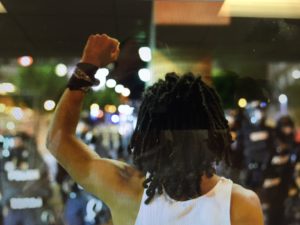
Hey guys! My name is Lauren Nalley and I’m a intern at Asheville Youth Mission this summer. I’m currently a sophomore in college in Colorado, but I am really excited about being able to work in Asheville this summer because this is where I was raised. I’ve lived in Asheville for 18 years and am super excited about giving back to the community which has given me so much in the past. My blog post this year is a video of spoken word slam poetry. I wrote this poem about my time in Asheville through out my life and what I have learned while being a part of AYM. It refers to many social justice issues which I have noticed in particular throughout these past weeks including homelessness, racism, police brutality , and many others. I hope you enjoy!
Every Wednesday evening, after groups have finished their last day of work sites and are participating in discussion and reflection during program, we do what we like to call “taking inventory”. We ask groups to reflect back on where they went, what they did, and who they met throughout the week. This is a time for them to recall favorite worksites, funny anecdotes, interesting observations, and meaningful interactions. It’s usually fairly easy to recall places they visited and things they did, but sometimes names slip away during the hustle and bustle of the day.
|
Archives
August 2023
Categories |
Youth Mission Co
 RSS Feed
Contact UsPO Box 2988
Asheville, NC 28802 (828 )231-4635 Mon - Fri 9 am - 5 pm EST 
|
SIGN UP FOR YMCO NEWSLETTER |
© Youth Mission Co. All rights reserved.